How to understand whether your promo pricing investment is paying
Let’s start with big industry NUMBERS… Ernest & Young reported that worldwide investment in trade promotion surpasses 1 trillion USD; in addition to this information, it’s worth noting that over the last 20 years trade spent has “grown from 13% of gross revenue to 20% average, while margins remained relatively flat. And that trend can’t continue indefinitely”. Another “heavyweight” McKinsey reports that 28 to 50% of retail sales volume across FMCG categories in Europe is based on promotion. Most likely if you read these numbers, and you are working for a FMCG company, probably looking into Profit and Loss statement you would see similar (if not worse/higher) figures.
So, to put it plainly if your company is making 10.000.000 USD/EUR yearly revenue, it’s likely that the company is investing up to 2.000.000 USD/EUR per year in promotional activities. Studies show that this is becoming the biggest single cost within the P&L structure for a lot of companies.
It’s your biggest cost/investment… so “is this investment paying off”?
Most companies tend to keep a close eye on the costs. Operational Expense – travelling cost, gasoline, meals, office space, salaries, bonuses… Capital Expenditure – cars, trucks, machines… Financial expenses – cost of money, loans, transaction costs… – companies have clear ideas about all the above-mentioned cost, and their composition (what is the productivity of the employees for example), they have clear process of tracking and approval, and analysis which shows operational or financial rational (or both) for any of the above.
At the same time, most of the companies don’t have a slightest clue if their promotional investment is paying off. What is the proper way to calculate “return on promotional investment” or what is the process which should be introduced to have the best possible usage of the investment.
Let’s “break down” the promotional pricing in a couple of points:
- What is promotional pricing?
- How is it used?
- Typical types of promotional pricing
- What is the best possible promo price?
- How to do the math – is your investment paying off?
What is promotional pricing?
Promotional pricing is a sales strategy which companies use to temporarily reduce the price of a service or a product in order to attract consumers.
Important note here – key word in the sentence above is “temporarily”. If your promo window is too long, it becomes a “permanent price reduction”. Same thing applies if the frequency of your promotional offers is such that it creates a sense of prolonged promotional pricing.
How is it used?
Promo pricing is greatly popular strategy as we can see from the 1 trillion USD yearly investment information used in different industries: consumer goods, retailers, service providing, B2B companies, and many more. In this article I am focusing mainly on the consumer goods companies which use this strategy for a number of reasons, so here are a few: 1) new launch, so called “introduction TPR” (temporary price reduction) for a new product/brand/line. Promotional pricing is often supported by additional visibility from retailers and e-retailers, so this helps create a buzz over a new launch (with extra visibility and if properly executed additional points of sale) 2) reward loyal customers. Every product/brand has a certain number of loyal consumers, and a promo pricing can be directed to reward them and protect this base from other competitors/substitutes. 3) increase the market share/category. Pricing is a great opportunity to attract new consumers. By reducing a price for a limited time period, product can change the pricing segment where it regularly competes, allowing the consumers of different pricing segment to try your product (or even consumers from a different category) and leverage the price/benefits. 4) remove excess inventory, pretty straightforward no need to explain.
Different part of the question is “who is accountable” for these decisions? Watch out here – “who is” and “who should be” can give you a completely different set of answers. Pricing is a sales strategy, but from my point of view, on the operational and executional side. Decisions on “how to play” pricing game is more in the realm of marketing department (if not decided differently of course).
Typical types of promotional pricing
I would start this part with saying, always try to avoid declaring something like “regular promotions”. If you start using nonspecific attributes like “regular”, then you will never build up a culture of business mindful decision making within the company you are working for. So, let’s list some of the typical types of promotional pricing: 1) flash sales – a short time frame in which you execute a price off in a specific channel/customer. 2) coupons – is a voucher related pricing promotion which is entitling the voucher holder to get a discount for a particular product. 3) loyalty promo – rewarding your consumers who frequently make the purchases. It is more costly to acquire a new consumer than to keep the current consumer base. 4) occasional tie-ins – using certain occasions throughout the year to tie your pricing promotion to the occasion – different celebration days – from festivities, new year occasions, Black Friday… what is interesting to note here is that connecting your pricing promo to a specific occasion can allow you to execute more aggressive pricing activities without deteriorating your brand image. 5) specific segment promo – promo pricing activity which is targeting a specific consumer segment e.g. retired consumers, seniors, military/police personnel, students, teachers, etc.
Most probably a good pricing strategy would involve a mix of the types mentioned above in correlation with the category you are competing in. Things which you need to take care about when preparing the pricing plan, is the “cost to serve” of the promotion, or to be more precise regular trade conditions and costs which a specific channel or customer carries (customer/channel mix). Another huge impact is quality of implementation – where you need to be clear on the sales implementation team, how, what and when needs to be executed.
What is the best possible promo price
Best possible promo price is literarily one you can withstand as a company. Ask yourself 3 questions in this part of the process: 1) Can you withstand the business spike – price promotion is not just affecting the profit and loss of promoted products, but also creates higher product demand, influences increased operation in different segments… 2) Do this price point damage the brand perception? You need to be watchful what can a certain price promotion do to your brand perception and value. In terms of high fashion companies, they tend to rather destroy the remaining stock versus organizing a price promotion. 3) What is the mathematics which is going to help me calculate the potential? Before giving a “green light” to a certain promotion, make sure you have clear assumptions on the effects. I say assumptions, as there are external factors that are not under your control. What sort of uplift I am expecting with X investment? Does the expected uplift justify the X investment? What will happen to my sales and consumer base after the promotion, and how my mid-terms business looks like from the viewpoint of organizing such a promotion? These are just some of the questions that should be incorporated into your promotional approval process!
How to do the math – is your investment paying off
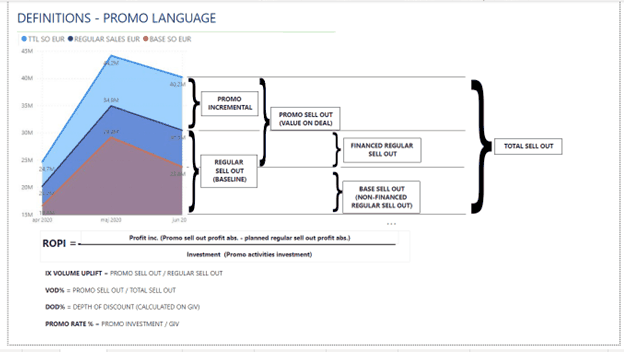
Above picture can be a good start for you to understand the mathematics of your promotional investment. Your Total sales consist of a) Baseline sales b) Promotional Driven Incremental. Your Promotional Sell Out is going to consist of the part already in your baseline sales (consumers which would purchase your product/service regardless of promotion) and promotional incremental. Add time before, during and after promotion to the “equation” above, and you will start to grasp the mathematics of promotions.
If you have interest to further explore how to improve your promotional strategy, promo price, effectiveness, optimization, return on promo investment make sure you reach out to us in CONSULT1.